
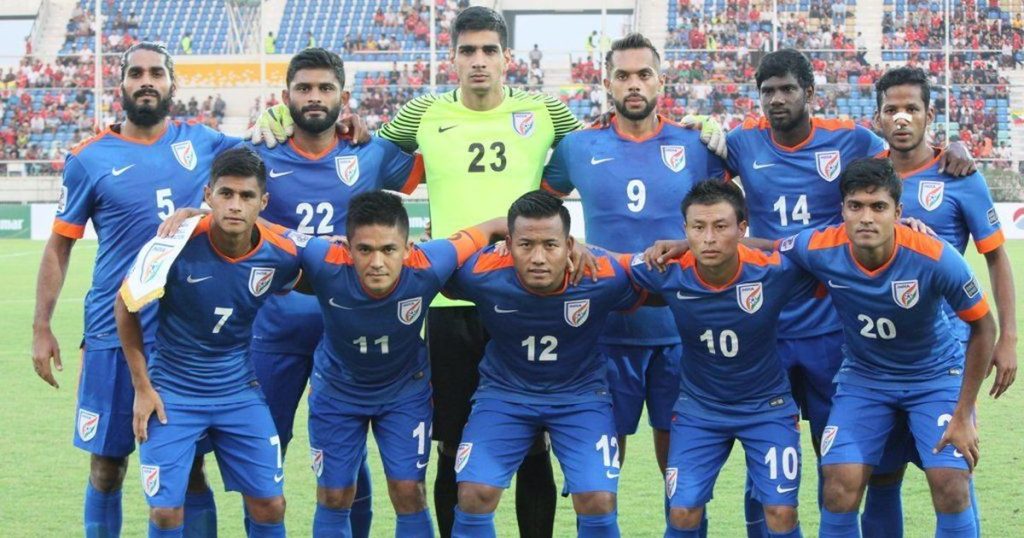

India’s FIFA ranking is an important measure of the national football team’s standing in international football. It reflects how the Blue Tigers perform against other national teams and how consistently they collect points in recognised international matches.
India has experienced several highs and lows since FIFA introduced its world rankings in 1992. The team reached its best position of 94th in February 1996. It later dropped to 173rd in March 2015, its lowest position in the ranking system.
The team made a strong recovery under coach Stephen Constantine and returned to the top 100 in 2017. It reached 99th in July 2023 but has struggled to maintain that progress.
As of the latest available live ranking snapshot on 10 November 2026, India are listed at 138th in the men’s FIFA World Ranking, with 1,086.43 points. This is a provisional live position rather than a new official ranking release. FIFA’s India association page lists 7 October 2026 as the last official update and 18 November 2026 as the next scheduled update.
What Is India’s Current FIFA Ranking?
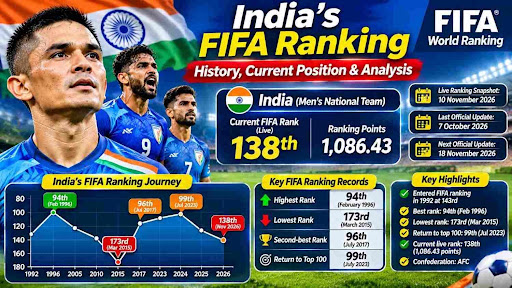
As of the latest available live tracker snapshot on 10 November 2026, India are listed at 138th in the men’s FIFA World Ranking with 1,086.43 points.
This live position is not a new official FIFA ranking release. FIFA’s India association page lists 7 October 2026 as the last official men’s ranking update. The next official update is scheduled for 18 November 2026.
India’s Current FIFA Ranking at a Glance
| Category | Details |
| National Team | India Men’s Football Team |
| Popular Name | Blue Tigers |
| Live FIFA Rank | 138th |
| Live Ranking Points | 1,086.43 |
| Live Ranking Snapshot | 10 November 2026 |
| Last Official Ranking Update | 7 October 2026 |
| Next Official Ranking Update | 18 November 2026 |
| Highest FIFA Rank | 94th |
| Highest Rank Achieved | February 1996 |
| Lowest FIFA Rank | 173rd |
| Lowest Rank Achieved | March 2015 |
| Confederation | Asian Football Confederation (AFC) |
The men’s ranking is separate from the FIFA women’s world ranking. India’s position in this article refers only to the men’s senior national team.
India FIFA Ranking History: From 1992 to 2026
FIFA introduced its men’s world ranking in December 1992. India entered the system at 143rd. The team made considerable progress during the early years and reached the top 100 in 1993.
Its best period came in February 1996, when India climbed to 94th. However, the team could not maintain that position and experienced a long decline over the following years.
The ranking history shows how results, international competition and consistency have influenced India’s position.
India’s Highest and Lowest FIFA Rankings
India’s highest FIFA ranking is 94th, achieved in February 1996. Its lowest position is 173rd, recorded in March 2015.
The difference between these positions is 79 places. It highlights the scale of India’s decline before its recovery under Stephen Constantine.
| Record | Ranking | Date |
| Highest FIFA Ranking | 94th | February 1996 |
| Second-best Ranking | 96th | July 2017 |
| Return to Top 100 | 99th | July 2023 |
| Lowest FIFA Ranking | 173rd | March 2015 |
| Live Ranking | 138th | 10 November 2026 |
India’s FIFA Ranking by Year
The following table shows India’s highest and lowest positions in selected years. It helps explain the team’s major periods of progress and decline.
| Year | Highest Rank | Lowest Rank |
| 1992 | 143 | 143 |
| 1993 | 99 | 129 |
| 1996 | 94 | 124 |
| 2000 | 106 | 122 |
| 2005 | 127 | 135 |
| 2010 | 130 | 160 |
| 2015 | 141 | 173 |
| 2017 | 96 | 132 |
| 2018 | 96 | 102 |
| 2019 | 101 | 108 |
| 2020 | 104 | 109 |
| 2021 | 104 | 107 |
| 2022 | 104 | 106 |
| 2023 | 99 | 102 |
| 2024 | 117 | 127 |
| 2025 | 127 | 142 |
| 2026 | 136 | 141 |
Note: The 2026 figures represent the year-to-date ranking range in FIFA’s available summary, not a completed calendar-year record. India’s live position of 138th on 10 November is shown separately.
In 2024, India reached 127th as its lowest position of the year before finishing at 126th in the December ranking update. These figures represent different points in the same year and are not contradictory.
How Did India Reach Its Best FIFA Ranking of 94?
India achieved its highest FIFA ranking in February 1996. The team had made progress in the early years of the ranking system and entered the top 100 in 1993.
However, the 94th position was not the start of a sustained rise. India struggled to maintain consistent results against stronger international opponents.
The team gradually slipped down the rankings. By March 2015, India had fallen to 173rd.
The decline reflected several challenges, including inconsistent international performances and difficulties in maintaining a strong run of results.
India’s Recovery Under Stephen Constantine
India’s recovery began under English coach Stephen Constantine, who returned for his second spell as national team coach in 2015.
When he took charge, India were ranked 171st. The team dropped to 173rd in March 2015 before beginning its climb.
India produced a series of positive results in international matches. Its 2–0 aggregate victory over Nepal in the 2018 FIFA World Cup qualifying preliminary round helped the team move up the rankings.
The national side also recorded important results in the 2019 AFC Asian Cup qualifying campaign. By July 2017, India had climbed to 96th.
This was the team’s best ranking since February 1996 at that time. India also reached 97th in 2018 and remained around the top 100 for several ranking releases.
India’s FIFA Ranking Between 2018 and 2023
India enjoyed a relatively stable period between 2018 and 2023. The team generally stayed between 96th and 109th during these years.
The national side benefited from regular international matches and positive performances in regional competitions.
Under coach Igor Stimac, India won the Intercontinental Cup and SAFF Championship in 2023. These results helped the team climb to 99th in July 2023.
It was an important milestone because India had not been inside the top 100 since December 2018.
However, the team could not maintain its progress. A difficult run of results in 2024 and 2025 caused a significant fall in the rankings.
Why Did India’s FIFA Ranking Fall After 2023?
India’s ranking decline after 2023 was linked to disappointing international results.
The team struggled at the 2023 AFC Asian Cup, which took place in January 2024. India lost all three group matches and failed to score a goal.
The team also experienced difficulties in the second round of 2026 FIFA World Cup qualifying. India collected limited points and did not progress to the next qualifying round.
These results affected its FIFA ranking points. India fell to 117th in February 2024. It reached 127th as its lowest position during the year before finishing 2024 at 126th.
The decline continued during 2025. India reached 142nd in November, its lowest position since 2016, and finished the year at the same ranking.
However, the live ranking position had improved to 138th by 10 November 2026. This was four places better than India’s position at the end of 2025, although the team remained outside the top 100.
India’s Latest International Results in 2026
India played several international matches during September and October 2026. The team drew 1–1 with Panama before losing 0–4 to Brazil and 1–6 to Uruguay.
The Panama draw took place on 25 September at Sree Kanteerava Stadium in Bengaluru. India then faced Brazil on 3 October and Uruguay on 6 October, with both matches taking place in Kolkata.
India subsequently began its SAFF Championship 2026 title defence with a 3–2 victory over Pakistan on 5 November at the National Stadium in Dhaka. India established a 3–0 lead through Suhail Ahmad Bhat’s brace and Manglenthang Kipgen’s goal.
Pakistan, coached by Nolberto Solano, scored twice in stoppage time to reduce the deficit. Alamgir Ghazi scored one of the late goals with an overhead kick. However, India held on to secure a 3–2 victory.
On 11 November, India defeated the Maldives 1–0 in its final Group B match. Suhail Ahmad Bhat scored the winning goal from the penalty spot in the 38th minute. Goalkeeper Priyansh Dubey also made important late saves to preserve the clean sheet.
The victory took India to six points and confirmed its position at the top of Group B. The defending champions qualified for the SAFF Championship semi-finals, where they are scheduled to face the runner-up from Group A on 14 November.
India are the defending SAFF champions and are chasing a record-extending 10th title. The tournament final is scheduled for 17 November, with all matches being played at the National Stadium in Dhaka.
There is also a split-squad arrangement during this international period. The SAFF Championship side is led by India U-23 head coach Naushad Moosa, while the senior national team is coached by Khalid Jamil. Jamil’s senior squad is scheduled to play two friendlies against New Zealand: the first in Auckland on 12 November and the second in Christchurch on 15 November.
Some players initially selected for the SAFF squad have been named in the New Zealand-bound senior squad and will join Jamil’s team rather than continue in Dhaka.
These matches and squad arrangements provide useful context for understanding India’s international football activity in November 2026. The live FIFA position may change as eligible international results are processed and approved.
India’s Recent International Results
| Date | Match | Result |
| 25 September 2026 | India vs Panama | 1–1 |
| 3 October 2026 | India vs Brazil | Lost 0–4 |
| 6 October 2026 | India vs Uruguay | Lost 1–6 |
| 5 November 2026 | India vs Pakistan | Won 3–2 |
| 11 November 2026 | India vs Maldives | Won 1–0 |
India’s Upcoming International Fixtures
| Date | Match | Venue |
| 12 November 2026 | New Zealand vs India | Go Media Stadium, Auckland |
| 14 November 2026 | SAFF Championship semi-final | National Stadium, Dhaka |
| 15 November 2026 | New Zealand vs India | One New Zealand Stadium, Christchurch |
| 17 November 2026 | SAFF Championship final | National Stadium, Dhaka |
Note: India’s SAFF semi-final opponent will be confirmed after the final Group A match. The final fixture is subject to India qualifying.
How Does FIFA Calculate India’s Football Ranking?
FIFA uses the SUM system for its men’s world ranking. It replaced the previous average-based system in August 2018.
Under this method, teams gain or lose points after international matches. The number of points depends on several factors.
1. Match Result
Winning a match can increase a team’s points, while losing can reduce them. A draw may also affect the total depending on the teams’ ratings and the expected result.
2. Strength of the Opponent
Beating a highly ranked team can provide a bigger advantage than defeating a lower-ranked opponent. The system considers the difference between the teams’ existing points.
3. Importance of the Match
Not every international match carries the same weight. Major tournament matches and qualifying games generally have greater importance than ordinary friendly matches.
4. Expected Result
FIFA’s system considers what result should be expected based on the teams’ relative strengths. A team can gain more by producing an unexpected positive result.
FIFA does not award a fixed number of points for every win. The points change depends on the match’s importance and the difference between the actual result and the expected result.
This means India’s ranking does not depend only on the number of matches it wins. The quality of opponents and importance of those matches also matter.
What Does India Need to Improve Its FIFA Ranking?
India needs consistent international performances to move up the FIFA rankings.
Improve results against Asian teams: Matches against AFC opponents are important opportunities to collect ranking points. India needs stronger performances against teams placed above it.
Perform better in qualifiers: World Cup and Asian Cup qualifying matches carry significant importance. Winning these fixtures can help India build points.
Develop attacking consistency: India has struggled to score regularly against stronger opponents. Better finishing and chance creation can improve results.
Build a stable national team: Regular selection, clear tactics and player development can help the team perform more consistently.
Use international windows effectively: Competitive matches against suitable opponents can provide valuable preparation and ranking opportunities.
A return to the top 100 will require sustained improvement. One successful tournament is unlikely to be enough.
Conclusion
India’s FIFA ranking has changed considerably since the system began in 1992. The team reached 94th in February 1996 but later fell to 173rd in March 2015.
Under Stephen Constantine, India recovered and returned to the top 100 in 2017. It reached 99th again in July 2023 before suffering another decline.
India finished 2025 at 142nd. By the latest available live ranking snapshot on 10 November 2026, its position had improved to 138th in the men’s FIFA ranking, with 1,086.43 points. This is a provisional live position, not a new official ranking release. FIFA’s next official update is scheduled for 18 November 2026.
The 3–2 victory over Pakistan and the 1–0 win against the Maldives gave India a successful start to its SAFF Championship title defence. The Blue Tigers finished top of Group B and advanced to the semi-finals. However, the team still needs consistent results against strong international opponents to return to the top 100 and maintain a sustained rise.
Frequently Asked Questions
India are listed at 138th in the live men’s FIFA World Ranking in the latest available snapshot dated 10 November 2026, with 1,086.43 points. This is a provisional live position. The next official ranking update is scheduled for 18 November 2026.
India’s highest FIFA ranking is 94th. The team achieved this position in February 1996.
India’s lowest FIFA ranking is 173rd, recorded in March 2015.
India returned to the top 100 in July 2023, when the team reached 99th. It had previously reached 96th in July 2017.
India can improve its ranking by winning more international matches, performing well in major competitions and earning positive results against stronger opponents. Consistency across international match windows is important.